Davis sits on I-80, 15 miles west of Sacramento, built around a research university campus and constrained by an urban growth boundary that limits new development at the edges. The result is a compact city of roughly 70,000 people where the established neighborhoods are mostly 1950s through 1990s builds and the inventory of single-family homes stays consistently tight.
Housing Stock
The neighborhoods closest to downtown — Old North Davis, East Davis, South Davis — are largely postwar and 1960s ranch houses and modest two-story homes, most on lots running 4,000 to 7,000 square feet. Mace Ranch, east of Pole Line Road, was developed in the 1990s and early 2000s, with larger lots and newer infrastructure. Wildhorse, in the northeast quadrant, is similar vintage, with a mix of single-family homes on 6,000- to 8,000-square-foot lots.
Condos and townhomes make up a significant share of the for-sale market; the university draws a substantial renter population, and developers have built accordingly.
The Zillow typical home value for Davis was approximately $838,000 in August 2026. Inventory is consistently constrained — the urban growth boundary limits outward expansion, and the core neighborhoods turn over slowly.
Commute to Sacramento
I-80 east is the direct route. On-ramps at Richards Boulevard or Mace Boulevard put you on the freeway; without traffic, downtown Sacramento is 15 to 20 minutes. That window holds reasonably well through 7:30 a.m. eastbound; after that, the backup through West Sacramento adds time. The reverse commute — Sacramento to Davis in the evening — is typically lighter.
Highway 113 south to I-5 is the route for reaching South Sacramento or Elk Grove.
Amtrak Capitol Corridor
Davis has a staffed Amtrak station at 840 Second Street, Davis, CA 95616. The Capitol Corridor line runs multiple daily trains between Sacramento and San Jose, with Davis as a stop. Sacramento is about 20 minutes by train; San Jose is roughly two hours depending on the service. This is one of the few Sacramento-area suburbs with a usable rail connection toward the Bay Area for work trips that do not require a car at the destination. Schedules and reservations are at amtrak.com/stations/dav.
Cycling Infrastructure
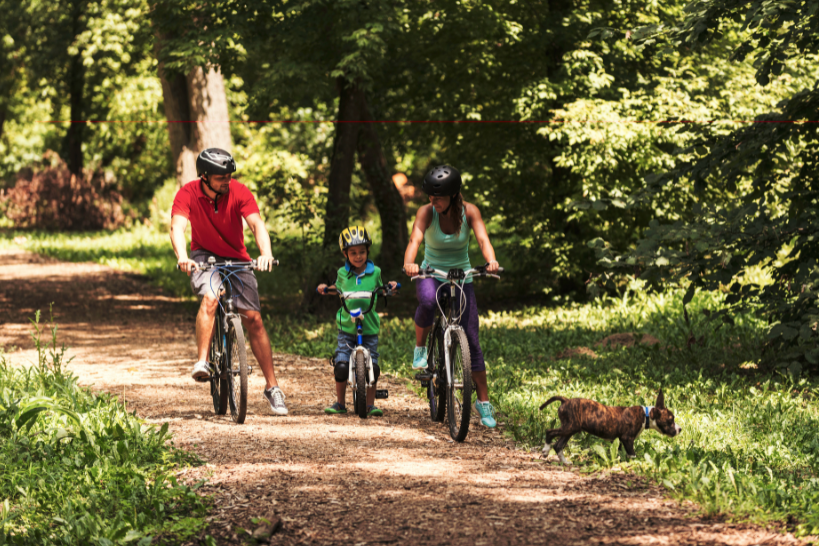
Davis has an extensive network of separated bike paths and marked lanes — routes along the Putah Creek Greenbelt, paths connecting to the UC Davis campus, and lanes through the downtown grid. The flat terrain keeps cycling practical year-round. The main path network links Central Park, the Amtrak station, campus, and the core residential neighborhoods, making many local trips genuinely car-optional.
Parks
Central Park, at Fifth and C Streets downtown, is the main public green space — open lawn, sports courts, and a farmers market on Saturdays and Wednesdays. The UC Davis Arboretum stretches 100 acres along Putah Creek through the campus and is open to the public year-round. Slide Hill Park and Oak Avenue Park serve the northeast; Mace Ranch Park and Manor Park cover the east and south sides of the city.
Utilities Setup
- Electricity and gas: Pacific Gas & Electric (PG&E) — set up service at pge.com or call 1-800-743-5000
- Water: City of Davis Utilities — contact through the City’s website when establishing residency
- Trash and recycling: City of Davis collection; enroll through the City when you set up utilities
DMV
The closest full-service DMV is in Woodland: 2050 East Gibson Road, Woodland, CA 95776, approximately 10 miles north via Highway 113.
Coming From the Bay Area
The comparison that comes up most often: Davis has supply constraints similar to many Bay Area suburbs — the urban growth boundary limits new inventory — but at a lower absolute price. A three-bedroom detached home in an established Davis neighborhood at around $838,000 would price at $1.4M to $1.8M in a comparable Bay Area suburb. The trade-off is distance: the Bay Area job market is 80 miles west, manageable on the Capitol Corridor for some trips but not as a daily drive.